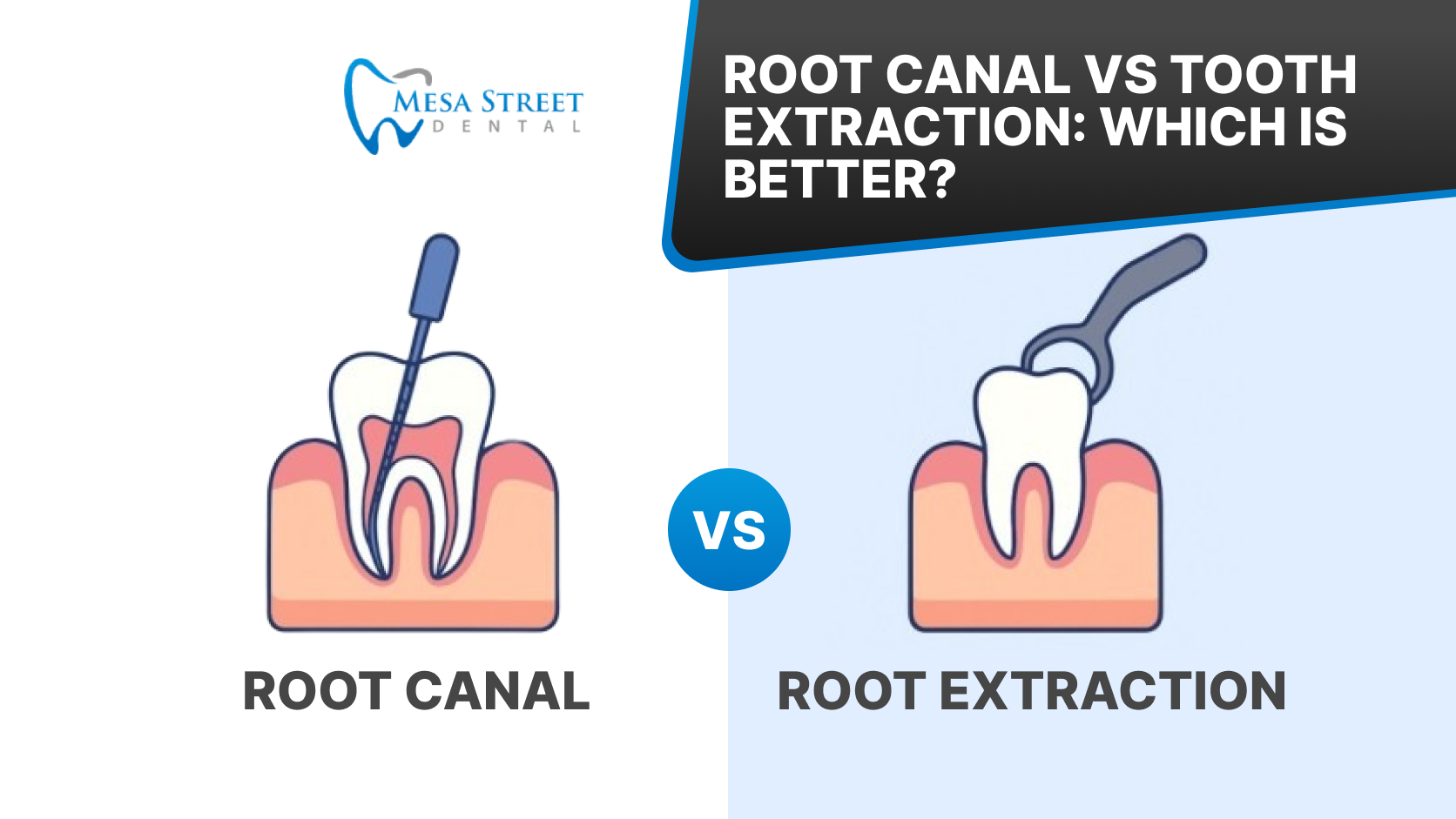
When a tooth hurts badly, it can feel easier to just remove it. But in many cases, saving your natural tooth with root canal therapy may be the better long-term choice.
Tooth pain can make every normal thing feel hard.
Eating hurts. Drinking something hot or cold hurts. Sleeping can be difficult. Even thinking about calling the dentist can feel stressful.
And when the pain gets bad, many people ask the same question:
Should I get a root canal or just have the tooth pulled?
This is one of the most common dental decisions patients face. The honest answer is that it depends on the tooth. If the tooth can still be saved, a root canal is often the better long-term option because it keeps your natural tooth in place. If the tooth is too broken, cracked, loose, or infected beyond repair, extraction may be the safer choice.
At Mesa Street Dental in El Paso, root canal therapy is offered as a tooth-saving treatment that removes infected or inflamed pulp, cleans the inside of the tooth, and helps protect the natural tooth from further infection.
So let’s break it down in simple words.
Quick Summary: Root Canal vs Tooth Extraction
| Question | Root Canal | Tooth Extraction |
| Main goal | Save the natural tooth | Remove the tooth |
| Best for | Infected tooth that can still be restored | Tooth too damaged to save |
| Tooth remains? | Yes | No |
| Replacement needed? | Usually no, but crown may be needed | Usually yes, with implant, bridge, or denture |
| Healing | Often a few days of soreness | Gum and bone need time to heal |
| Long-term concern | Tooth must be protected with filling/crown | Missing tooth can affect bite and nearby teeth |
| Better option? | Usually better if tooth can be saved | Better if tooth cannot be restored |
What Is a Root Canal?
A root canal is a dental treatment used to save a tooth that has infection or inflammation inside it.
Inside every tooth, there is soft tissue called pulp. This pulp contains nerves and blood vessels. If deep decay, a crack, or injury lets bacteria reach this area, the tooth can become painful or infected.
During root canal therapy, the dentist removes the infected or inflamed pulp, cleans and disinfects the inside of the tooth, then fills and seals it. After that, the tooth is usually restored with a filling or crown so it can function again. The American Association of Endodontists explains that root canal treatment helps preserve the natural tooth and may prevent the need for more extensive replacement treatment like a bridge or implant.
In simple words:
A root canal removes the infection, not the whole tooth.
What Is a Tooth Extraction?
A tooth extraction means the tooth is removed from the mouth.
Extractions may be needed when a tooth cannot be saved with a filling, crown, or root canal. This can happen when the tooth is badly broken, severely decayed, cracked below the gumline, very loose, or causing infection that cannot be predictably treated.
The Cleveland Clinic notes that dentists usually recommend extraction when other treatments are not enough to save the natural tooth.
In simple words:
An extraction removes the problem tooth, but it also leaves an empty space.
That empty space may need to be replaced later with a dental implant, bridge, or denture to protect chewing, bite balance, and smile appearance.
Root Canal vs Extraction: Which One Is Better?
If the tooth can be saved, root canal therapy is usually the better option.
Why?
Because your natural tooth is still valuable. It helps you chew, speak, smile, and keep your bite balanced. A root canal lets you keep that tooth instead of removing it.
The American Association of Endodontists says the major advantage of a root canal is that it preserves the existing natural tooth and helps avoid more extensive restorative treatment to replace it.
But this does not mean root canal is always the answer.
Sometimes extraction is better. If the tooth is too weak, too cracked, or too damaged to support a crown, saving it may not be realistic. In that case, removing the tooth and planning a replacement may give a better long-term result.
When a Root Canal May Be Better
A root canal may be the better choice when the tooth has infection inside but still has enough healthy structure to restore.
You may be a candidate for root canal therapy if you have:
- Severe tooth pain
- Lingering sensitivity to hot or cold
- Swollen gums near one tooth
- A pimple-like bump on the gums
- Darkening or discoloration of a tooth
- Pain when biting or chewing
- Deep decay close to the nerve
- A cracked tooth that can still be restored
Mesa Street Dental lists ongoing sensitivity, swollen gums, darkened teeth, severe pain, facial swelling, bad taste, and a pimple on the gums as possible signs that a root canal may be needed.
The goal is to treat the infection before it spreads, reduce pain, and avoid losing the tooth.
When Tooth Extraction May Be Better
Extraction may be better when the tooth cannot be saved in a healthy, stable way.
This may happen if:
- The tooth is cracked below the gumline
- There is not enough tooth left for a crown
- The tooth is very loose from gum disease
- The decay is too deep or widespread
- The tooth has severe trauma
- The infection cannot be controlled
- A wisdom tooth is causing problems
- The tooth is blocking orthodontic or dental treatment
This is why a dental exam matters. From the outside, two teeth may look similar. But X-rays and a clinical exam can show whether the root, bone, and remaining tooth structure are strong enough to support treatment.
Root Canal vs Extraction: Cost Difference
At first, extraction may seem cheaper.
A simple extraction can cost less upfront than a root canal and crown. But the long-term cost can change if you need to replace the missing tooth.
Mesa Street Dental’s own educational content lists root canals as generally ranging from $500–$1,200 depending on complexity, while a simple extraction may be around $150, with replacement options like implants starting higher. These are general educational estimates, and actual treatment cost can vary by patient.
Here is the important part:
| Cost Question | What to Think About |
| Is extraction cheaper today? | Sometimes yes |
| Will the missing tooth need replacement? | Often yes |
| Can a missing tooth affect nearby teeth? | Yes, teeth may shift over time |
| Can a root canal avoid replacement cost? | Often yes, if the tooth is restorable |
| Should price be the only factor? | No, long-term function matters |
So the better question is not only:
Which one costs less today?
The better question is:
Which one gives me the best long-term result?
Is a Root Canal More Painful Than an Extraction?
Many people fear root canals because they have heard old stories.
Modern root canal treatment is very different. With numbing and modern techniques, root canals are designed to relieve pain, not create it.
The American Association of Endodontists says root canal treatment is virtually painless and often leaves patients with less discomfort during recovery than having a natural tooth extracted.
Extraction is also done with numbing, but the healing process is different because the tooth is removed and the socket has to heal.
Both treatments can involve soreness afterward. But neither should feel like the scary version people imagine.
What Happens If You Pull a Tooth and Do Not Replace It?
Sometimes a patient thinks:
“It is just one tooth. I can live without it.”
And sometimes, depending on the tooth, that may feel true for a while. But missing teeth can cause problems over time.
A missing tooth may lead to:
- Nearby teeth shifting
- Bite changes
- More pressure on other teeth
- Chewing difficulty
- Jawbone loss in the area
- Food trapping
- Smile changes
- Higher chance of needing future dental work
That is why extractions are not always the “simple” option long term.
If a tooth must be removed, your dentist may discuss replacement options such as a dental implant, bridge, or partial denture. Mesa Street Dental also offers restorative options including dental implants, bridges, dentures, and All-on-4 implants in El Paso.
Root Canal vs Extraction and Dental Implant
A dental implant can be an excellent option when a tooth is already missing or cannot be saved. But if your natural tooth can be saved with a root canal, that may help you avoid implant treatment for that tooth.
Here is a simple comparison:
| Option | What It Means |
| Root canal + crown | Saves your natural tooth |
| Extraction + implant | Removes tooth and replaces it with artificial tooth root and crown |
| Extraction + bridge | Replaces missing tooth using nearby teeth for support |
| Extraction + denture | Removable replacement option |
Dental implants are strong and natural-looking, but they still require extraction, healing, implant placement, and final restoration. So if the tooth can be treated predictably, saving it may be simpler.
How Dentists Decide Which Option Is Right
A dentist does not decide based only on pain. Some badly infected teeth may not hurt much. Some painful teeth may still be very treatable.
Your dentist will usually look at:
- X-rays
- Tooth structure
- Crack depth
- Gum health
- Bone support
- Infection size
- Bite pressure
- Your medical history
- Your long-term goals
- Whether the tooth can support a crown
Mesa Street Dental uses services like digital X-rays, intraoral cameras, and CBCT technology as part of its dental care technology offerings.
The goal is to avoid guessing and choose the option that gives the healthiest result.
Myths About Root Canals and Extractions
Myth 1: “Extraction is always easier.”
Extraction may be faster in the chair, but it can create a new problem: a missing tooth. If that tooth needs replacement, you may need more visits later.
Myth 2: “Root canals are too painful.”
Modern root canals are done with numbing and are meant to remove infection and pain. Many patients feel relief after treatment.
Myth 3: “If the pain stops, the tooth is fine.”
Not always. Sometimes a tooth stops hurting because the nerve has died. Infection can still be present.
Myth 4: “A missing back tooth does not matter.”
Back teeth are important for chewing and bite support. Losing one can put extra stress on other teeth.
Myth 5: “The cheapest option is always best.”
Short-term savings can become long-term cost if the missing tooth causes shifting, bite issues, or needs replacement later.
Questions to Ask Before Choosing
Before saying yes to root canal or extraction, ask your dentist:
| Question | Why It Helps |
| Can this tooth be saved? | Helps you understand the real options |
| Is the crack or decay too deep? | Shows whether restoration is possible |
| Will I need a crown after root canal? | Helps plan cost and protection |
| What happens if I remove the tooth? | Helps you understand long-term effects |
| Do I need to replace the tooth? | Important for bite and smile planning |
| What are my replacement options? | Helps compare implant, bridge, or denture |
| Is this urgent? | Infection and swelling should not be ignored |
| What will my insurance cover? | Helps with budgeting |
Why Choose Mesa Street Dental in El Paso?
Mesa Street Dental offers complete dental care in El Paso, including root canal therapy, extractions, emergency dentistry, crowns, bridges, dentures, and dental implants. Their services page lists root canal therapy under restorative care and extractions under preventive services.
For patients with urgent tooth pain, Mesa Street Dental also mentions same-day emergency care on the homepage.
Patients may choose Mesa Street Dental for:
- Tooth pain exams
- Root canal therapy
- Emergency dental care
- Tooth extractions
- Same-day crowns
- Dental implants
- Dental bridges
- Dentures
- Clear treatment explanations
- Flexible financing options
- Insurance claim support
Mesa Street Dental is located at 5555 N Mesa St Ste 100, El Paso, TX 79912, and the office phone number is (915) 200-8111.
Conclusion
So, root canal vs tooth extraction: which is better?
In most cases, a root canal is better when the tooth can still be saved. It keeps your natural tooth, protects your bite, and may help you avoid replacing a missing tooth later.
But extraction is better when the tooth cannot be restored. If the tooth is badly cracked, severely decayed, loose, or structurally weak, removing it may be the healthier choice.
The best answer depends on your tooth, your X-rays, your symptoms, and your long-term oral health.
If you are dealing with tooth pain in El Paso, do not wait until the problem becomes more serious. Mesa Street Dental can help you find out whether your tooth can be saved or whether extraction and replacement may be the better path.
Your natural tooth is worth saving when possible. But when it cannot be saved, you still have options to restore your smile.
FAQ
1. Is root canal better than tooth extraction?
Root canal is usually better if the tooth can be saved. It keeps your natural tooth in place and may help you avoid replacement treatment. Extraction is better when the tooth is too damaged or infected to restore.
2. Is it cheaper to pull a tooth or get a root canal?
A simple extraction may cost less upfront, but replacing the missing tooth with an implant, bridge, or denture can add cost later. A root canal may be more cost-effective long term if it saves the tooth.
3. Does a root canal hurt more than an extraction?
Modern root canal therapy is done with numbing and is designed to relieve pain. According to the American Association of Endodontists, root canal treatment often causes less recovery discomfort than extraction.
4. When is tooth extraction the better choice?
Extraction may be better if the tooth is cracked below the gumline, too decayed to support a crown, very loose, or not restorable. Your dentist can confirm this with an exam and X-rays.
5. What happens after a root canal?
After a root canal, the tooth is cleaned, filled, and sealed. Many teeth also need a crown afterward to protect them from breaking and help restore normal chewing.
6. What happens after a tooth extraction?
After extraction, the gum and bone heal over time. Your dentist may recommend replacing the missing tooth with a dental implant, bridge, or denture depending on your needs.
7. Where can I get root canal therapy in El Paso, TX?
Mesa Street Dental offers root canal therapy in El Paso, TX, along with emergency dental care, crowns, implants, bridges, dentures, and tooth extractions.