

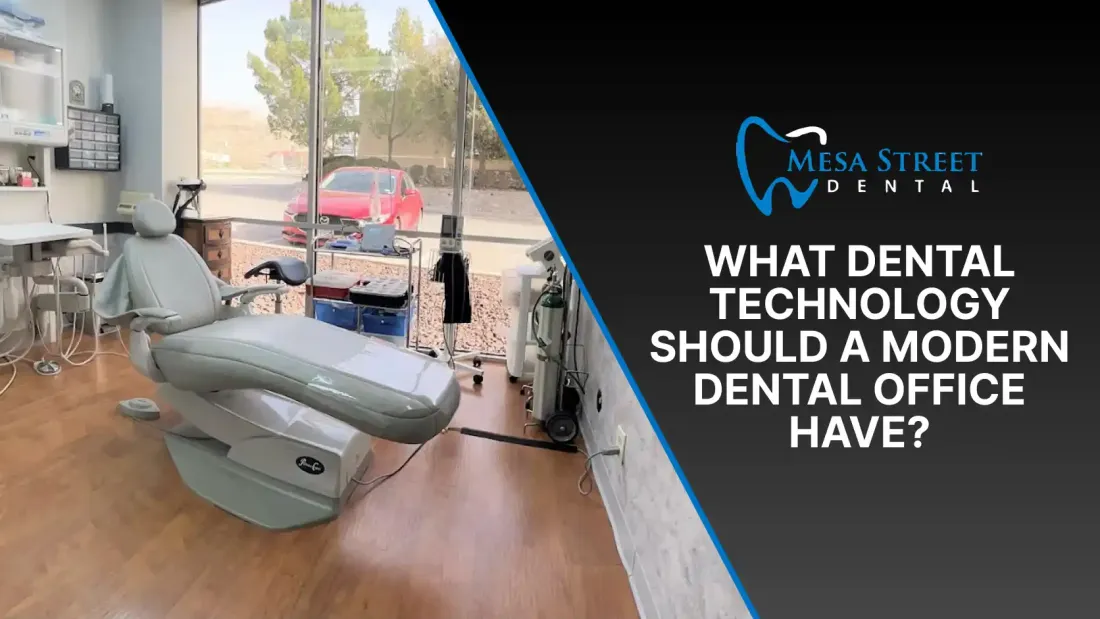
Modern dental technology can help dentists evaluate oral health, explain findings more clearly, and plan treatment using detailed digital information. But having the newest equipment does not automatically mean better care.
The value of advanced dentistry technology depends on how and when it is used. A dentist still needs to examine the patient, review symptoms and dental history, and determine which imaging or digital tools are appropriate for the individual situation.
At Mesa Street Dental, the technologies currently used include digital X-rays, intraoral cameras, CBCT/3D imaging, and CEREC technology for same-day crowns. These tools can support diagnosis, restorative treatment, implant planning, and patient education when clinically appropriate. The practice currently lists these technologies on its website.
The Role of Modern Dental Technology
Modern dentistry combines clinical examination with digital information when additional detail is useful.
Depending on the patient’s needs, technology may help the dentist:
- View areas that cannot be fully assessed during a visual examination
- Document conditions inside the mouth
- Evaluate teeth, roots, and supporting bone
- Plan certain restorative or implant procedures
- Explain dental findings to patients
- Digitally design selected restorations
These tools can support better dental treatment planning, but they should not be described as guaranteeing a particular result. Technology works alongside the dentist’s training and clinical judgment rather than replacing them.
Digital X-Rays for Dental Diagnosis
Digital X-rays are an important part of modern dental imaging. They allow dentists to examine structures that may not be visible simply by looking inside the mouth.
Depending on the type of X-ray and clinical need, dental imaging may help evaluate:
- Cavities between teeth
- Tooth roots
- Bone surrounding the teeth
- Existing fillings and crowns
- Impacted or developing teeth
- Certain infections or areas of concern
- Changes that require further evaluation
Digital images can also be viewed on a computer screen, making it easier for the dentist to review findings and explain them to the patient. Mesa Street Dental currently lists digital X-rays and diagnostic 2D imaging among the technologies used in its El Paso office.
Digital X-rays should be taken based on clinical need rather than simply because the technology is available.
Intraoral Cameras for Detailed Dental Images
An intraoral camera is a small camera used to capture close-up images of the teeth, gums, and existing dental restorations. Because the camera can show areas of the mouth on a monitor, it can be useful for both clinical documentation and patient education.
An intraoral camera may help show visible conditions such as:
- Cracked or worn teeth
- Damaged fillings
- Areas of visible decay
- Changes around the gumline
- Broken restorations
- Tooth surface wear
Seeing an image of the actual tooth can make it easier for patients to understand what the dentist is discussing. Mesa Street Dental confirms that intraoral cameras are part of its current dental technology.
Send Us A Message
CBCT and 3D Dental Imaging
CBCT stands for cone-beam computed tomography. Unlike conventional two-dimensional dental X-rays, CBCT can produce three-dimensional images of the teeth, jawbone, and surrounding structures.
This additional detail can be useful for selected procedures where the dentist needs more information about anatomy that cannot be adequately evaluated using 2D imaging alone.
At Mesa Street Dental, CBCT technology is used in areas such as dental implant planning. The practice states that CBCT 3D imaging, digital X-rays, and intraoral cameras are used to evaluate jawbone support and plan implant placement.
CBCT in Dental Implant Planning
Before dental implant treatment, the dentist may need information about:
- Available jawbone
- Bone dimensions
- Nearby teeth
- Implant position
- Surrounding anatomical structures
- The planned restoration
Three dimensional imaging can provide additional information to support that evaluation. For patients considering dental implants in El Paso, TX, CBCT imaging may be used as part of the planning process when appropriate.
Treatment still depends on factors such as oral health, bone support, bite, medical history, and the individual clinical situation.
CEREC Technology for Same-Day Crowns
One of the most significant technologies currently available at Mesa Street Dental is CEREC, a computer-assisted system used for selected same-day dental crowns. Traditional crown treatment may involve preparing the tooth, taking an impression, placing a temporary crown, sending information to a dental laboratory, and returning for another appointment when the final crown is ready. CEREC provides a different workflow for suitable cases.
Mesa Street Dental states that its CEREC system digitally maps the restoration, creates the crown design, and mills the crown on-site.
Digital Scanning and Crown Design
With CEREC technology, information about the prepared tooth can be captured digitally. The digital information is then used to design the restoration.
This computer assisted process allows the dentist to evaluate factors such as:
- Crown shape
- Fit
- Relationship with surrounding teeth
- Bite
- Restorative space
Digital technology can support the restorative workflow, but the final treatment still requires clinical evaluation and adjustment by the dentist.
In-Office Crown Milling
After the CEREC crown has been designed, the restoration can be milled in the dental office. Mesa Street Dental confirms that CEREC crowns are crafted on-site, with the technology used to digitally map, create, and mill the restoration. For appropriate cases, this allows same-day crowns in El Paso to be completed without waiting for a dental laboratory to manufacture the restoration.
The practice also notes that this workflow can eliminate the need for a temporary crown in eligible same-day cases. Not every damaged tooth will be suitable for a same-day crown. The dentist first needs to evaluate the tooth, remaining tooth structure, bite, and restorative requirements.
Technology for Better Dental Treatment Planning
One of the main benefits of modern dental technology is that different forms of clinical information can be considered together.
For example, a dental implant assessment at Mesa Street Dental may involve:
- A clinical examination
- Digital X-rays
- CBCT 3D imaging
- Intraoral images
- Evaluation of jawbone support
- Assessment of the bite and treatment area
Mesa Street Dental specifically states that it uses CBCT 3D imaging, digital X-rays, and intraoral cameras when evaluating bone support and planning implant placement. This additional information may help the dentist develop a treatment plan that reflects the patient’s individual anatomy and restorative needs.
Dental Technology and Clinical Precision
Improved dental accuracy is often discussed as a benefit of digital dentistry, but the wording needs to be realistic. Technology can support more detailed imaging, digital measurements, restorative design, and visualization.
For example:
- Digital X-rays can provide diagnostic information that cannot always be seen during a visual exam.
- CBCT can provide a three-dimensional view for selected treatment planning.
- Intraoral cameras can provide enlarged images of visible dental conditions.
- CEREC can use digital information to design and mill selected dental restorations.
- However, technology itself does not guarantee greater accuracy or a particular treatment result.
Clinical precision also depends on appropriate case selection, equipment use, interpretation of the images, dentist training, the patient’s anatomy, and the procedure being performed.
Technology and Minimally Invasive Dentistry
Minimally invasive dentistry generally refers to preserving as much healthy natural tooth structure as reasonably possible while addressing disease or damage. Digital tools may support more conservative treatment planning in appropriate situations by giving the dentist additional information about the tooth or surrounding structures.
For example, detailed imaging may help the dentist identify the area that requires treatment, while digital restorative technology may help plan a restoration around the remaining tooth structure. This does not mean that digital technology always results in less treatment.
If a tooth has extensive decay, a fracture, infection, or another significant problem, appropriate treatment may still require removal of damaged tooth structure or a more extensive procedure. The treatment should be determined by the clinical condition rather than by trying to make every procedure “minimally invasive.”
Modern Technology for Informed Dental Care
Patient Education With Digital Technology
Modern technology can also improve communication between patients and their dental team. A patient may find it difficult to understand a description of a crack, damaged filling, or bone level based only on verbal explanation. Digital X-rays and intraoral camera images allow the dentist to show the area being discussed.
This can help patients ask more informed questions about:
- The condition of the tooth
- Why additional evaluation may be needed
- Available treatment options
- Benefits and limitations of treatment
- What may happen if the condition is monitored instead
Technology should support informed decision-making rather than be used to pressure patients into treatment.
Technology Should Support the Dentist, Not Replace Clinical Judgment
A dental office should not be judged solely by how many devices it owns. A useful technology is one that helps the dentist provide appropriate care for the patient’s actual needs.
The dental team still needs to determine:
- Whether imaging is necessary
- Which type of imaging is appropriate
- Whether additional information will affect treatment planning
- Whether a same-day restoration is suitable
- Whether a patient is a candidate for implant treatment
- Whether referral or additional evaluation is needed
Good dentistry combines clinical examination, patient history, diagnostic information, technology, and professional judgment.
Modern Dental Technology at Mesa Street Dental in El Paso, TX
Mesa Street Dental currently provides several forms of advanced dentistry technology at its El Paso office.
The practice lists:
- Digital X-rays
- Diagnostic 2D imaging
- Intraoral cameras
- CBCT/3D X-ray technology
- CEREC same-day crown technology
- Digital crown mapping, design, and in-office milling through CEREC
The homepage specifically identifies intraoral cameras, digital X-rays, CBCT/3D imaging, and same-day crowns among the practice’s modern technologies. For implant treatment, CBCT imaging, digital X-rays, and intraoral cameras may be used to evaluate bone support and plan implant placement.
For eligible restorative cases, CEREC technology allows the practice to digitally design and mill same-day crowns on-site. If you are looking for an El Paso dentist, the dental team at Mesa Street Dental can evaluate your oral health and explain which diagnostic or restorative technology may be appropriate for your individual needs.